Showing posts with label Poplar. Show all posts

Sunday, June 17, 2012

Art of Fire - Forest Fire Leaves Art

ART
in the eye of the beholder

Walking in the smoke all day, may make my photographic eye a bit foggy.

No, blame the camera, it just could not catch the interesting forms left after the fire moved through the area.
I also did not have time to stand around thinking about the shape, the background, the lighting.
Branch of the birch tree burned well into the truck of the tree.

This stump in the cutover was hollowed out, leaving the burned roots exposed.

This white pine seems to be well protected by the thick bark. This may be the white pines first fire, and it may not be the last one it sees. 

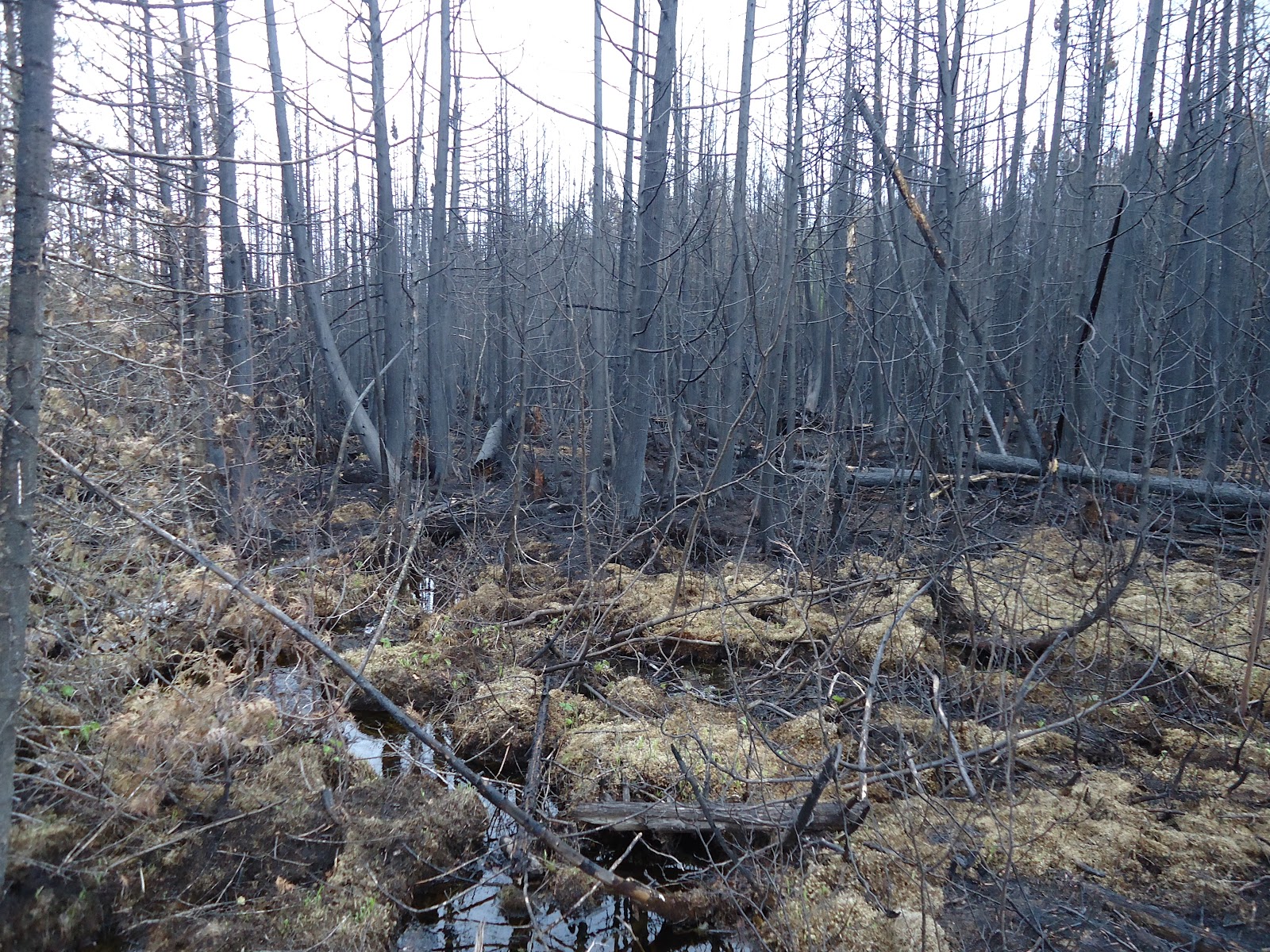
Usually the white cedar swamps do not burn. This fire the wind was high, the temperature was high and the relative humidity was low.  This swamp burned in the trees and the ground remained untouched in some places.

Looks like the fire burned fast over the ground. Some areas were missed and  it did not burn very deep.   Ferns continue grow, some even had the tips burn off and then just re-shoot.

This location was burned maybe a week before  I took this picture.  The little yellow needles on the ground are the dried needles off the tamarack.  When you walk the needles continuous fall.
 Fire a natural part of the forest ecosystem.


Thursday, May 5, 2011

Nature Deficit Disorder - have you been touched?


Are you Suffering?
Have you hugged a tree this week?

While driving into the forest the other day a story on CBC radio suggested we suffer from nature deficit disorder. We are are doing well as a species being taken out of the forests. They cited a study that proved young people did better if they were exposed to pine trees. I was driving past a Jack pine plantation with the window open at the time. Lucky me.

We are losing touch with nature, but more important we are losing contact. The smells and fell of the forest is important to human growth. The smell from the pines triggers something in our brains that just makes us more in-touch with our surroundings.

You need to plant a tree close to you, one every year. Why not plant a bonsai, then you can have a tree in your living space year-round. It is not hard. You can order a tree from Millson Forestry Service store in Timmins.

Nature Deficit Disorder links

Nature Canada - blog entry from 2008 describing the disorder
Best Health - What is nature deficit disorder?
PhD in Parenting - Cures for Nature Deficit Disorder? Help for our Planet?
Canadian Living - Quiz: Is your family suffering from nature deficit disorder?
Human Well Being and the Natural World - Just some facts
Canadian Institute of Forestry - Summer Outdoor Camps:  The best remedy for nature deficit disorder
Child and Nature Alliance - Get outside!!
Evergreen.ca they need contact with nature
Psychology TodayExploring the natural world's psychological effects on human beings.
Education.comThe Critical Role of Environmental Education for your Child’s Future
An Interview with Robert Batemanincreasingly popular term among educators

Frogs are Greendefinitely what the doctor ordered.

National Environment WeekTake the Nature-Deficit Disorder Survey Here

Trees we see plenty. It is green grass we do not get to see or smell for many months. So every year we grow our own grass in the house. A different container every year. When the kids were smaller we grow a big tray of grass to hide easter eggs in. It is wonderful to smell the grass after a trim with scissors. Looks like my grass is due for a trim this weekend.

Oxygen Grows On Trees

Saturday, February 26, 2011

Black Bear Stick Nest

It is a real thing!!

I got a picture this week of a classic Bear Stick Nest.  I was first introduced to the black bear stick nest during a stick nest workshop.  We were looking at many different types of stick nests and learning how to identify which bird had created the nest.

In the case of the bear stick nest - it is not a nest at all.  Rather it is a place where a bear sat and eat the buds off the branches of a tree. The mess that is left behind once the bear has broken many branches in the tree, can be confused with a real stick nest.

This is the second bear stick mess I have got a picture of.  Maybe one day I will get a picture of the bear in the tree while making the mess.

View in Google Maps

Bear Stick Mess (Nest)

Friday, November 5, 2010

Hiking Day in Timmins

What a great day.

Great turn out too!

Hiking Day at Hersey lake Conservation Area.

The trails offer smooth walking trails and signs to make sure you do not get lost. Distance at each sign means you can plan the distance you want to walk.

Great event, hope you can come out next year.

Saturday, July 31, 2010

Ontario Honour Roll of Trees

Ontario Honour Roll of Trees - Updated!

For the longest time the Ontario Honour Role of trees has been a broken link. The Ontario Forestry Association has updated their site and the honour roll is once again front and center.

Take a look at the Ontario Honour Roll.

Take a look at the Timmins Honour Roll.

The Timmins Honour Roll needs your help to be completed. If you can fill in a blank with a big tree please let me know. Maybe we even have the biggest in Ontario!!

Tuesday, March 9, 2010

Hawk Owl likes harvest operations

Hawk Owl has followed operations over the years.

I have heard many stories of these little birds following machines in the bush. One operator has told me that some bird - that looked like the bird I pointed out - would dive under logs that were being lifted by a machine.

I kept my eye on a hawk owl one year during the 3 months of winter operations. This little bird was there watching until the last load of logs was dropped on a trailer.

Watching the bird that year was my introduction.

This year a little hawk owl was hanging around again. It is easy hunting for squirrels when many of the trees are out of the way.

I took a picture with my little camera, I pointed out the tiny bird with an arrow. I also got a picture with my digital binoculars, the camera part is not very good.


Tuesday, March 2, 2010

Spring is just around the corner

Spring is just around the corner.

I am thinking about all the new life I am going to be seeing very soon. Also thinking of visiting some old friends too, namely the biggest White Pine in the area.

We have some trees on the Timmins Homour Roll of Trees, but we still need you to find us find some giants of other species.

We have
Eastern White Cedar
Eastern White Pine
Red Pine
Jack Pine
Tamarack
White Spruce
Black Ash
Aspen
Yellow Birch

We need examples of
Black Spruce
Balsam Fir
Red Maple
Balsam Poplar
White Birch

A very big Burr Oak was pointed out to me this winter during the Christmas Bird Count. I will get the diameter this spring. A big blue spruce was also pointed out to me on the front lawn of a house.

I will get a picture with the owner of the tree this spring and post it here.

keep on the look out for honour trees, and let me know when you find one!


Monday, November 16, 2009

Beaver Busy Before Winter

Beaver love aspen trees, more commonly called a poplar. Bark, buds and branches of the aspen tree are favorite.

This very large aspen tree is showing the strength of wood. The top of the tree is very branchy and heavy, yet less then a third of the truck is left.

When the beaver returns it will have to be very careful to move away as the tree falls. It is going to fall right on to a road as another one had done maybe a week before.


Hinterlands Who's Who The beaver

Adopt-A-Pond The beaver

Borealforest.org The Aspen tree

Timmins Honour Roll of Trees Largest Aspen Tree


Tuesday, September 15, 2009

Sudbury is getting Greener - Slowly

Recently I was in Sudbury for a Saturday night, and a Friday night too. I was there for a Regional Local Citizen Committee Conference.

Our field tour on Friday afternoon was to look at the regreening of Sudbury.

Many years ago the mining of Sudbury metals created a ring of destruction around the mining complexes due to pollution coming from the mills.

Since the 1980's the regreening efforts have taken barren lands that could not grow anything and created lands capable of supporting vegetation. It will be many more years before the forest return the Sudbury basin, but at least the effort is being put forward.

Pictured below is what the ground has looked like over the last 50 years with nothing growing except some poor white birch and some mosses. Other picture is of ground that has had lime added to reduce the acid, seeded to grasses and clover and fertilized, then finally trees planted.

The white pine seem to be doing really well on the site. I hope over the long term the area is able to recover to again produce great trees that will create oxygen for all of us!


Do you want to plant your own tree or purchase a tree that will produce oxygen.

Friday, May 15, 2009

Bird and Bud

Today I watched a bird and I saw some buds. You just got'a love spring.

I have been watching the growth of a honey suckle for about 07 years now. I noticed it growing in a white spruce plantation that had plenty of poplar competition when I was in the block doing some tending.

I have tried to start cuttings from it, but have not been successful.  How do I regenerate the honeysuckle? If you know - tell me.

The poplar are not yet bursting their buds, but the honeysuckle already have leaves starting to show.  I just love the way the honeysuckle wrap around the poplar, twisting around itself and the poplar stem and branches.

Humming birds enjoy the sweet nectar the flowers produce.

The white spruce are doing very well. 

On the way out of the bush I watched a bird fly across the road. It was a woodpecker, but not one of the small ones. I watched the bird for awhile and figured it must be a black backed woodpecker.

It is a little bigger then the downy and the hairy woodpeckers, with a very black back. The woodpecker was not alone because like Canada Geese  they mate for life. The pair moved around the forest with ease landing on trees that would provide some food.

I took the picture of the woodpecker with my camera-binoculars.  Too bad the picture does not turn out as good as what I see through the binoculars.


Tuesday, April 7, 2009

Forest Research Partnership in Timmins

The Forest Research Partnership has a project here in Timmins, just 24km down Pine street south.

Highlights for me include the discovery of 400 year old white cedar and bird study part of the project.

The block also has the biggest white pine in the area. (see the Honour Roll of Timmins Trees)

Three different orchids - I will have to follow up on what those three are when I am in the same place as my notes.

A wonderful yellow birch stand was discovered in the block and management techniques were used to continue the health of the stand. This is the only yellow birch managed stand in the north, since yellow birch is at the northern edge of their range.

---------------------------------------------------------------------

The project team is working to merge high-tech inventory with leading-edge forest modeling and silvicultural science with operational practice, to set the standard for the credible implementation of enhanced forest productivity. Specifically, integrated harvest-to-harvest sequences of best practices are being implemented that include components such as:

1. State of the art spatial modeling to aid in prime site selection.

2. Enhanced forest inventory to optimize operational planning, including block and road engineering.

3. Careful, high-utilization logging

4. Thorough mechanical and/or chemical site preparation

5. Timely planting or high quality stock, including the best genetics available and species matched to microsite.

6. Timely and effective vegetation management.

7. Density regulation defined by long-term crop plans.

Within each of these components, new knowledge and tools are being fully implemented to operationally test and validate their integrity.

See the newest report and past reports.

Wednesday, February 25, 2009

Biofuel created by a wood hog near Timmins Ontario

See the video Mulcher Wood Hog Timmins Ontario. You can take a look at how the slash left over from a harvest operation is turned into a fuel that will be burned to create electricity.

This harvest operation is what we call mechanical. Fellerbuncher fells the trees, then a grapple skidder pulls the bunches of trees roadside. Once roadside the tree is either processed or delimbed, sometimes both.

What is left behind from that process is the tops, branches and leaves. It is this biomass that is placed in the mulcher to create a material that can be fed into power plants.

The Centre for Energy is just one of the very many Canadian site on the topic, but it has a very good general overview of the bio energy sector.

The material from this block is destine for facilities operated by Northland Power. One facility is the Kirkland Lake Generating Station, the other facility is the Cochrane Generating Station.

muddy mark webpage

Saturday, November 29, 2008

New Addition to Timmins Honour Role of Trees

Don Buck from OMNR has found the biggest Aspen and Tamarack trees. They have been added to the Honour Roll. These trees are the first of each species to be added, but Don and I agree the record will not stand for long.
I am sure this summer a bigger Aspen will be found.
Just a note about Poplar and Aspen. Typically, in this area, Aspen (specifically Trembling Aspen) is called Poplar, while Balsam poplar is also called Poplar (sometimes called black poplar or just Bam).

Timmins Honour Role of Trees