Saturday, August 29, 2009

Nighthawk Common this summer

I have seen so many Nighthawks this summer. I have seen a couple during the day, which I think is a little unusual.

The flight of a nighthawk is unmistakable. The wing bars really stand out when in flight.

The other day at the office a nighthawk sitting in the back was pointed out to me. I happened to have my video camera with me that day and thought I would walk to the end of the greenhouse to see if the bird was still sitting there. The bird had found a location that blended in well with. It is certainly hard to see if you were not looking for it.

Dan said he had been right up beside it with the tractor and it did not even fly away. I am guessing it was just waiting for the evening onslaught of bugs. The bugs have not been as plentiful this year, maybe due to the cool wet summer. Maybe they need to spend more time searching for food so are extending the feeding hours?

Near Timmins we have Nighthawk lake, Nighthawk forest, and many Nighthawk businesses.

For more information about the bird I have included a few links below.


Millson Forestry Service is where the bird was seen. Here is a map.


I have a 10 second video, like I have done before, but I just can not get it to work. I will try again tomorrow, maybe it is on their end.


Wednesday, August 19, 2009

My Puddingstone visit, pictures and maps

The glacier brought the stone within one hundred kilometers of Timmins, Larry brought it the rest of the way.

I just had to go visit this interesting find. I do see many puddingstones, the in-laws are in puddingstone country - near Sault Ste Marie. They have a stone similar to this one on their front lawn. Many stones line the driveways on Puddingstone road.

12000 years ago the glacier retreated and must have brought this rock with it. I wonder where the rock really came from. I hope someone can give us some insight about this.

The first picture is where the rock has been sitting for the last 12000 years. That rock has seen many different forests. The forest has grown and burnt and grown again. This rock will now view the world from it's new urban home.


Where it came from map

Where it sits now map

All the pictures I took today are here

Send me a picture of yourself sitting on the rock, I will add it to the web album.

Tuesday, August 18, 2009

Timmins Likes Pudding Stone

A 10-ton mosaic rock, discovered in the bush about 60 kilometres west of Timmins, has found a new home in Flintstone Park on Rea St. N.

Larry Robichaud, who made the geological find while camping west of the Groundhog River in Reeves Township a year ago, said this product of volcanic process is quite unique for Northern Ontario and has drawn the interest of the Geology Department at the University of Toronto.

"My first impression was that it looked like a block of cement with lots of rocks in it," said Robichaud, who noticed it just off a bush road in Reeves Township when he was camping by himself for a week last August. "I started looking at it more closely and it struck my interest. I did some research and found out that it was a puddingstone. It would have come here from down south."

He said the rock could have only arrived here after being carried and dumped by a receding glacier during North America's last ice age.

A puddingstone, also known as zenolith, is a sedimentary rock that consists of a mixture of different, irregular sized grains and pebbles held together in a matrix of finer materials such as sand.

It was only after speaking with geologists at the University of Toronto that Robichaud felt some effort should be made to bring it to Timmins where others could see it for themselves

"They told me, 'If you ever get to move it, we'd like to come see it.' That kind of convinced me that more people needed to see this."

Robichaud was able to achieve this last week with assistance and support with the Mattagami Region Conservation Authority and the crane operating firm of RLP/CMS.

Last Wednesday, Leo Madore, crane operator for RLP/CMS and Robichaud spent six hours unearthing, hoisting, loading up, and relocating the huge rock using a 26-ton boom truck to Flintstone Park.

In keeping with its new location, Robichaud said the rock has been named Fred's Puddingston

Daily Press Story

Wikipedia

Pudding stone
blog


Sunday, August 16, 2009

Garden Growth and Spotted Tussock Moth

Oxygen is growing in my garden big time this year. Last year I did not have any peas, but this year the garden is able to keep up to the grabbing hands of my guys and the little ones next door. The carrots are great and the goldfinches are already plucking at the sunflowers. The kids are learning what the finches sound like when they are flying overhead. They now know 2 birds by their sound, robin and goldfinch.

Last year, no corn. This year I am sure we will get 10 cobs of corns!

Morning Glory's are taking over everything. They are up the corn and sunflowers, tangled in the peas and wrapped around the carrots. The pretty flowers they produce will attract the humming birds soon. The garden is a little too crowded this year, but I just can not bring myself to remove anything, after last years poor showing.

Timmins is starting a community garden program, I think it will be up and running next spring. Stay tuned in - when I know, you will know

I guess the Earth Machine composter in the middle of all this growing is using some of the O2, but is also producing some great soil for next year.

You can not see the pair of goldfinches on the sunflowers, I did not know they were there until after I took the picture.

While walking back into the house a little Spotted Tussock Moth (Lophocampa maculata) was walking across the grass. I brought it into the house and put it on my young lads bare back. He is very use to his Dad doing things like this. He did not jump, he barely looked up from his computer. "Ya dad what is it"?

He played with it as I looked it up online. Ya just got to love how easy it is to identify anything with a few key strokes. To see what the adult will look like or for more information check out the links below.

Wednesday, August 5, 2009

Wild Orange Daylily - Learn something new every day


You can see the map to see where I was, but I did not know we had these around.

I have never seen them around Timmins before. They are very nice looking. I came across this little patch of plants while out looking at a property for a Toronto client. They are actually growing on his property along the road. I figure they must have been planted there many years ago since much of the land in the area is long abandoned fields.

Look close at the pictures and you will see the rain. Did it ever come down while I was taking the pictures. I was on the way back to the truck, but I just had to stop and get some pictures. You can see one flower is full of water and in another picture you can see the rain coming down on the road.

What I have learned about the plant is it has become an invasive species here in Ontario. It is a plant that does very well and will push native species out. It is considered an invasive species in southern Ontario, maybe it would be considered a protected species here in the North.

Let me know if you see more of these plants around, or other interesting plants. Send me pictures I will post them here.

eNature information


Tuesday, August 4, 2009

Learning about Trees

It is wonderful to see so many people come out to learn about trees.

I spent the weekend at Kettle Lake Provincial Park and had the opportunity to invite campers on a hike to talk about trees and birds in the park. We did not see many birds, but we did stop and look at a large ant hill that had been disturbed by a bear.

Picture 1 : poster showing the areas planted and areas burned.
Picture 2 : I walk and talk with the group
Picture 3 : We had a little guy keep us on track with a GPS unit. Total walk 2.25km


Scotch Pine Provenance Test

I think this is the oldest trial ever installed in the Timmins District. The test is also just another wonderful story about trees in the park. Where is it - map

Much of Kettle Lakes Provincial Park was planted after being harvested and burned. A very unique method of tree planting was used for a large area - machine planting. A machine is pulled behind a tractor, a furrow is created, the tree is placed in the furrow while it is filled back in - the tree is planted!

One of the early tree planting efforts in the park was a scotch pine provenance test. A provenance test compares trees from different locations. In this case trees seedlings, or maybe the seeds and seedlings grown here, came from many different location in Europe.

The scotch pine, also known as scots pine, is doing just fine in the park. The trees are a little deformed, but are becoming spread thoughout the park. This makes me wonder - when a tree species that is not native begins to spread in a provincial park - when does it become an invasive species?

Everything you always waanted to know about scotch pine is here

I have been taking visitors to see the scotch pine for many years. I have had visitors from Finland and Sweden that have been very interested in seeing trees that came from their country.

Represented are: Cevennes, Auvergne, Adirondack, W. Europe, Finland, Sweden, L. Austria, E. Baltic, Haute Loire, S. Finland, and W. Baltic.

I am not sure where some of these places are, well except for Finland, I got that one.

Picture 1: A scotch pine
Picture 2: corner marker, made to last
Picture 3: corner marker, made to last


Kettle Lakes - Trees for Canada

The Boy Scouts of Canada had a program called Trees for Canada, that changed maybe 10 years ago to a program called Scoutrees.

The very first Trees for Canada in the Timmins area was planted inside Kettle Lakes Provincial Park. The records indicate that a total of 11000 white spruce and jack pine were planted near Irrigation Lake.

The white spruce have been growing slower then the jack pine, which is common. White spruce can handle the shade created by taller trees. When the taller trees die out and allow more sunlight to reach the ground the white spruce will take off.

It is just another wonderful story about trees in the park.

I was not around Timmins in 1980, but I was involved in every plant from 1986 to 2003. I do not know if the Scouts have planted since then. The first plant I attended in 1986 was just south of the Deloro landfill. The container type was 408 paper pot. The container was made of paper and pulled apart from the other tree seedlings. Many trees were planted a little too high and left a little bit of paper showing. Crows from the landfill came over and pulled out hundreds of the trees.

It looked like someone had come the day after the plant and just pulled out every tree. Some were sitting up on stumps and some were even sitting in the trees. Those curious birds!

Picture : Line of planted white spruce trees, first Boy Scout Tree Plant in the Timmins District.
Taken : August 03, 2009
Location : map


Year Township Number and Species

1980 German (KLP) 11 000 White spruce and Jack pine

1981 Massey 10 000 Jack pine

1982 Carscallen 10 000 Jack pine

1983 Denton 8 525 White spruce

1984 Carscallen 5 000 Jack pine

1985 Murphy 5 000 Jack pine

1986 Murphy 5 000 Jack pine

1987 Deloro 5 000 Jack pine

1988 Deloro 5 000 Jack pine

1989 Evelyn 5 000 Jack pine

1990 Little 6 150 Jack pine

1991 Macklem 5 000 Jack pine

1992 Macklem 5 150 Jack pine

1993 Macklem 4 400 Jack pine

1994 Evelyn 2 500 Jack pine

1995 Evelyn 4 500 Jack pine

1996 German 3 500 Jack pine
**********100 725 seedling to date!***********

1997 German? 3000 jackpine

1998 German? 3000 jackpine

1999 German? 3000 jackpine

2000 German? 2500 jackpine

2001 Tisdale 2000 Jack pine

2002 Tisdale 2000 Jack pine

2003 Tisdale 1 600 White spruce and 100 White pine

Sunday, July 26, 2009

Carbon Planet Blog

This is another blog that is not a grounded as I feel this one is, but some great information and thoughts.

Check it out.

Another Blogger with great content

Welcome! I'm a freelance outdoor photographer from Ontario, Canada. This blog is where I share my recent photos and adventures. I'm currently on a 1.5 year photo road trip traveling around North America in a camper van - and you can follow the trip right here! --Ethan

http://ethanmeleg.blogspot.com/

Boreal Songbird Initiative

This seems to be a very good link. More relative to the west side of the country but great info. and pictures.

Dr. Jeff Wells is the Senior Scientist for the Boreal Songbird Initiative. During his time at the Cornell Lab of Ornithology and as the Audubon Society's National Conservation Director, Dr. Wells earned a reputation as one of the nation's leading bird experts and conservation biologists. He is now dedicated to understanding and protecting the land where North America's birds are born and raised, the Boreal Forest of Canada and Alaska. Check back regularly to read Dr. Wells' perspectives on the conservation, migration and interesting habits of Boreal birds.

Thursday, July 23, 2009

Timmins Bridge to Bridge Trail

Today I had the day off, it gave me a chance to take a little ride on the "bridge to bridge" trail. It is a great little trail. It winds along the river with many places to sit and look at the scenery.

Today a family of mergansers was sitting just in front the bench where Roll'n and I stopped for a drink. Roll'n had a drink, I just watched.
The trail is lined with many different tree species. All of the tree are very young, since, I am guessing with floods and lake shore logging all the big trees have been removed over time.

The first picture is on the east side of the river looking north north west. map
The second picture is across the river looking east south east. map
The third picture is a nest site set up many years ago to attract a Osprey. It has remained empty for many years but Osprey are in the area, so it is available. Maybe some year a raven will start a nest and make it more appealing to owls and other birds of prey. map


Sunday, July 12, 2009

Spittalbug

This year I have noticed many plants with spittal on them. Looks like someone has been walking around with soap in their mouth and spitting on the plants.

On closer inspection the bubbly mass on the plant is the protective home of the spittlebug.

enature: "Spittlebug nymphs cover themselves with masses of bubbly, wet spittle, which accounts for their common name. Each frothy mass contains 1 or more tiny nymphs, effectively hiding them from predators as they suck plant juices."

These little bugs like all kinds of plants. At the greenhouse I have seen them on different species of trees.

Next time you see the little bit of, what looks like spit, push it aside to revel the little creature inside. This is where I saw these flowers, but you can find them just about everywhere - map

While taking pictures of the uncovered little creature a fly came to be part of the picture. Glad it droppped in, it is great for size comparision.


Wednesday, July 8, 2009

Wild Columbine in Full Bloom

I have never noticed this flower before.

I stopped at a water crossing to look into the water while waiting for a skidder to catch up. On both sides of the road growing above the culverts were these neat tall flowers. map

Turns out to be Wild Columbine. Not a rare plant, rather common the documentation tells me - I just never really noticed it before, I guess.


Tuesday, July 7, 2009

Bur Oak - Timmins Honour Roll of Trees

Yes Bur Oak in Timmins!

This tree was planted in Kettle Lakes Provincial Park in the 70's I am told. Many different kinds of trees came from a southern Provincial tree seedling nursery to the park. There is also many honey locust and one white ash. The ash is smaller then the oak, but it is just as old and just as strong.

The park is also home to 2 Provenance tests. One is scotch pine and one is red pine. The scotch, or scots, pine test has trees that came from many different countries. You can see trees that have come from Finland, Austria, Adirondock, Baltic, Sweden and a few other countries.

The red pine provenance test represents seed sources from all over southern Ontario. Maybe as we talk more about global warming these trees will do better up here then they would have in the south?

One other aspect I find great about Kettle Lakes is the fact that much of it was machine planted. It is very flat and sandy. You can still see the furrows that were created during the trees planting.

I think I was on a similar tree planing machine when I worked at a tree nursery on southern Ontario.

I added this tree to the Timmins Honour Roll of Trees. I also added a note on the FaceBook Group Oxygen Grows on Trees.


Tundra Swan Swimming in Timmins

Once again Lynn has provided us with a great photo of a bird visiting Timmins. The tundra swan is very cool to see, but her pictures of the Wimbrel are really special. See previous entry.

The tundra swan is a frequent visitor to Timmins over the years, since we are on the migration path. This one was seen swimming at Kraft Creek. map I always like to hear about sightings in Timmins and area and I add them to the Observations Naturally webpage

The mute swan is also on the Timmins Checklist of the Birds, listed as an accidental. It has been on the list for many years and I do not know the details around the sighting.

Thanks Lynn


Thursday, June 25, 2009

Is Potting Tree Planting

The last couple of days I have been working in the greenhouse potting tree seedlings. I like to think of it as tree planting! I am just planting them first, before some else will plant them.

I was planting black spruce and jack pine. In a little more then a month the seedling should be pot bound enough to be planted outside. One day one of these trees may end up on the Timmins Honour Role of Trees as the largest example in the area.

"Pot bound" is when the roots take up enough of the pot that it holds all the soil into a compact ball of roots. When you flip the pot over and remove the pot you can see healthy white root tips, the tree is ready for planting.

White pine were also potted recently, but I was not the one doing it. They look great. Who
ever buys these white pine will be buying the Provincial tree on Ontario. The Arboreal Emblemof Ontario.

Another activity going on in the greenhouse, while I was tree planting, is thinning. In the picture below Annie is thinning. When the seeding machine drops seed into the container sometimes more then one seed lands and germinates. It is important that every container only has one tree seedling. The doubles are removed while the seedlings are still tiny. It is easier to do it before the roots get tangled.

The seedling will grow and become root bound in the container, same as a potted plant only on a smaller scale. The seedling will be removed from the container, with soil encased in roots, to later be planted. In some cases the entire container will go to the field and the tree planter will remove the trees, pack them into their bags and plant them.


Monday, June 22, 2009

Whimbrel Update

More information happened to come to my email this week regarding the whimbrel.

There has been some great work tracking a number of whimbrel on their migration path.

Find it here at the Center for Conservation.

Take a look at the project and the tracks. Some do come very close to Timmins.

If you missed the story of the Timmins whimbrel you will find it below.

Friday, June 19, 2009

Tree Plants

Here is a group shot of the tree planters the other evening, thanks Len.

Now more trees are growing oxygen here in Timmins.


Want to get your own tree to plant? These trees were provided by a local grower. Buy Local!

Roll'n is looking good, if he had a hat on he would look like me.

Thursday, June 18, 2009

Eurasian Collared-Dove

Here is a great observation recorded that is very interesting. I got a call and had to go take a look. It was great we could sit at the kitchen table and watch the bird. I was able to walk around and find the mate.

I want to hear about great sightings in and around Timmins. Be great if you leave a comment too.

2004 entries on the Timmins Naturalists Species Observation page:

December 18, 2004 Timmins Christmas Bird Count. Combining the feeder and field results in 889 individuals, 13 different species and 21 participants. Of note is Canada goose and theEurasian Collared-Dove. This dove was spotted about 4 km west of the previous sighting.

December 4, 2004

By Paul Gaudreau : An
Eurasian Collared-Dove has been at his feeder for a number of weeks. Today I was able to confirm with him that there actually was a pair of doves in his back yard. This really is an unusual observations and I wonder if the birds are escaped pets. Will post here if I find out.


It has been a few years and the birds have never been spotted again.

Wednesday, June 17, 2009

Tree Plant on Tailings, Walking on Rock.


This evening the Porcupine Watchfull Eye group meeting was a field trip. I love field trips!

We met on the Carium road to visit the Coniaurum tailings rehabilitation area (map). While we were there we had a tree plant. We planted Jack pine, White spruce, Red pine and White pine.

In the picture we have Larry just finishing up planting a perfect tree - green side up! We also have Larry and Sylvie (Timmins Naturalists Members) plant with Laszlo adding a layer of mulch to help reduce grass competition around the tree. In total another 20 trees have been added to the rehabilitation effort this evening.

These tailing are covered with bio-waste from the Abitibi paper mill, then seeded to grasses, sedges and clovers and I guess what ever else blows in. There is wide variety of plant life greening the landscape.

A little fox is searching the tall grass for little critters to nibble on. No bears this evening. We also visit the site of soon to be bee hives. Last year the bee hives produced honey from the nectar found in the plants on the tailing. The honey turned out great, I am told. I have seen it but not tasted the sweet liquid.

The bears are kept at bay from the honey with the help of a solar powered electric fence. Poor bears.

We leave our little trees in their new home and head for the Simpson Lake trail (map). It is a trail in progress that will follow a path up waste rock to provide the traveler with a great vantage point.

Monday, June 15, 2009

Snapping Turtles in Timmins

Yes we do have snapping turtles in Timmins.

A discussion about turtles on the weekend prompted me to look back at the last couple of snapping turtle sightings.

June 2006 Mac sent me an email declaring "Newly discovered value" He found the turtle near the Grant mill in the west end of town. He helped it to the river at the bridge behind Grants.

This is the first snapping turtle I have ever seen up here in the north. When I was a young strapping lad paddling a canoe on the 16 mile creek in Oakville I saw many very large snapping turtles. You think you hit a rock and then the rock moves.

Once I found a bunch of baby snapping turtles along the shore while fishing.

September 2008 I was surprised to read about a snapping turtle in Porcupine. The turtle was crossing the road when spotted by a bunch of youth. So if you are out swimming in the Porcupine lake this summer keep an eye out for the large moving rock.

Let me know if you have seen a snapping turtle or any turtle in the Timmins area. I have a great story about painted turtles I will post later.


Sunday, June 14, 2009

Timmins Naturalists

There seems to be a buzz in the community again about observations of the birds and the bees. There is alot going on.
Timmins Orchid, bee hives on tailings, big trees, whimbrel, sandhill cranes, turtles, water, windmills, dams, caribou and white moose.

With digital cameras very popular there are some great pictures of wildlife that need to be shared. Look at the great pictures Lynn got of the whimbrel!

I have began work on the reconstruction the Timmins Naturalist website. I thought it was still on the web someplace but I could not find it. I could not even find it on my computer. I found an older version on a backup to get started.

If you are so inclined take a look, come back in a couple of weeks as I update it when I have time.

Still waiting for reports on big trees to add to the Timmins Honour Roll of Trees.

Thursday, June 11, 2009

Stuck a Red pine in the eye of the Earth

Look at the shape of the area of poor nutrients. A look from the sky.

It takes the shape of an eye. I first noticed the shape while looking at aerial photography in the early 90's and thought I would take a look at it on the ground. Maybe it just needed more trees to provide shade and stabilitiy.
When with OMNR I took 2 students to plant trees in many differnet places. I have looked at some of the places and the Red pine are taller then I am, but not here. I planted in the eye on the earth with many different people over the years and I know that Denis planted here too with a youth group, I think.

Many trees were put in the eye of the Earth, with the same result for all.
The Red pine in these pictures are the size of a 3 year old tree, but are actually more then 15 years old. Some are really great examples of a bonsia.

Wednesday, June 10, 2009

White Birch Tar - Do It Yourself

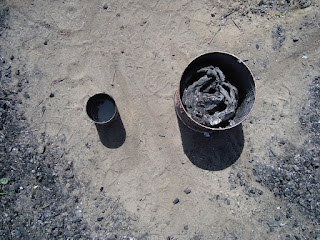
I made birch tar.

I was super surprised how much tar a little bit of birch bark produced.

I stuffed a coffee can full of birch bark. Put it in a fire for an hour and out came about third of a soup can of birch tar. Maybe I am leaving out a few small details about the process, since the entire process would be better described with an entire web page with many pictures. It will follow soon.

The tar was similar to the tar I would put on the bottom of my wooden cross-country skis. Smelled the same and felt the same.

I boiled down the tar until I ended up with more of solid when it cooled. A brittle solid.

Solid birch bark tar.

The huge amount of tar in the bark must be why the wood will rot before the bark. Often I find tubes of birch bark with the wood gone and the bark in good condition.

Look at other posts below and you will see many examples of birch tubes.

Want to have a birch tube of your own, check out this site.


Sunday, June 7, 2009

Arbor Day 2009 Yesterday

It was a little cool on Arbor Day, but it would have been perfect if we were actually in the field planting trees.

This year we split up to be in 3 different locations. East end at the water park on Porcupine Lake, Gillies lake and west end at Mountjoy Historic Park. I was at the Mountjoy park with Ben and Kiri.

The last couple of years we have been asking for a donation to cover the cost of the tree seedlings and as a way of raising money for the Wintergreen Fund for Conservation. Millson Forestry Service gives us a very good deal on the trees, but they are not free.

Your donation also got your name entered into a draw for a bat box and a swallow house. Good homes for great bug eaters!

If you missed Arbor day and still want tree seedlings you can get many different sizes and species at the store. Seed soource is important. Trees that come from a local seed source will do better then those that come from a seed source other then here. Trees do not like to move north
, that is why tree seedling from local seed source will always do better then outside sources.

A little more then 1000 white spruce tree seedlings were handed out. That is another 1000 trees going in the ground to help the environment and help keep Timmins beautiful. Many told me they would also plant one at "camp".

"The best time to plant a tree is 100years ago, the second best is today"

Kiri, a Katimavik participant from Nova Scotia has been with us for the week, want to try her hand at creating a bonsai, or maybe she will just plant it here in Timmins before she leaves.

Friday, June 5, 2009

Arbor Day 2009 Tomorrow

Tomorrow is Arbor Day in Timmins

For a donation to Wintergreen Fund for Conservation you can get a white spruce tree.

more about the event tomorrow

Wednesday, June 3, 2009

How do trees grow up?

The other day I was driving through a spruce plantation. The leader of some the the trees were incredible. Many in the plantation were more then 50 cm in length and a couple of the superstars were in the 90 cm range.

How do trees grow?

Here is a question I ask of everyone that comes on a tour with Muddy Mark, at the greenhouse, or on a hike with me at Kettle Lakes Provincial Park.

The tree we are standing beside is about 20cm in diameter. This tree grows about 50 cm in
height every year. Today we put a mark in the tree, we will come back in 10 years.

How high will the mark
be when return?

It will be at the same place! Why? Trees only grow up at the tip. In forestry lingo it goes something like " the meristematic tissue elongates"

What is in the pictures is last seasons height growth. The growth is fantastic! If trees grow like this every year the trees would cast shadows for kilometers. Tree growth slows as they age.

Trees grow in diameter, that is why you can count the tree rings to determine the age.

Want to learn more? Try these links.